Saturday, August 29, 2015

Finale for Trips in South America: Inca Avalanche to Machu Picchu (Peru)

Inca Avalanche (Peru)

This adventure began with a sketchy, shaking encounter with a highly unprofessional AIRPORT taxi driver.  Feel free to ask me about this, but what I'll post on here are the lessons learned:  

1) Sit in the back of the taxi always. (In La Paz, it was of no consequence, but I was not familiar with Peru and should have taken more caution.)
2) ALWAYS have your luggage with you (not in the trunk --even if they offer) in the event you need to exit unexpectedly.
3) Hold your ground. (This was effective in this case, anyway.)
4) Ask locals or friends what the fare should be ahead of time, as online estimates may be off or just incorrect.  I had assumed La Paz rates, but had overshot the actual rate.


So here's the story.  Mike was competing in a bicycle competition called The Inca Avalanche in a village named Ollantaytambo.  He left earlier in the week with other competitors, but I could not take off work, so I left on Friday after work to meet him there.  The flight and the collectivo (similar to a city bus) ride went smoothly, but the distance from the flight to the collectivo was covered via taxi, as I could not walk.  Ultimately, I, and my belongings, got to Mike safely.  I enjoyed seeing him and the other guys race down from the snow-covered, mud-ridden summit to the tropical trail at the finish line.  (Although, someone attempted to steal Mike's iPhone from me as I tried to film the beginning of the race.  Watch your items, people!  Especially if you have blond hair, blue eyes, fair skin, and no obvious companions--native or foreign... I was never in mortal danger, but the events that started my experience in Peru left me with a sense of apprehension for the rest of the trip.)

After the race, there was a celebration and award ceremony--complete with long-winded speeches and fountain fireworks that gently blazed past those standing on the Redbull canisters and tickled the top and edges of the fabric canopy.


Soraypampa Trek (Peru)

After the bicycle competition, we left Ollantaytambo to meet up with Michael's mother, Mary, and sister, Jennifer, in Cusco, who had flown down to complete a trek to Machu Pichu with us.  To allow them to acclimate to the high altitude, we took a city tour and learned about the Incan empire and visited some historical sites and museums.  We tried fruits, learn about medicinal spices, and inquire about some of the shaman remedies for purchase in the indoor marketplace.  The architecture and landscaping of many ancient sites is stunning and the sacred temples were awe-inspiring.  For example, all holy places were lined with multi-ton rocks so well-formed that no adhesive agent was necessary to keep the rocks in place --only the engineering of the walls was necessary.  

For example:  


After Mary and Jennifer had acclimated, we began a four-day unveiling of the Peruvian Andean Mountain Range.  We rode horses, hiked up cliff-sides, down steep slopes, and across landslides to the humming of insects, singing of birds, and rhythm of our and others' footfalls.

This is a lake that we got to hike to the afternoon before our four-day journey.


A gentleman making fresh coffee for hikers.


At the end of our trek, we reached the city of Aguas Calientes, where we rested before heading up to Machu Pichu.  Back in civilization, we got a chance to rest in a hotel and take much-needed showers before exploring the more touristic aspects of the city.

Machu Pichu (Peru)


As a wonder of the ancient world, Machu Pichu's reputation precedes itself.  Regardless, nothing could have prepared me for the magnitude of its simple elegance and distinct cooperation between the design of the city with respect to the nature that surrounded it.  Below I have some photos of the city itself, and of our trek to the Sun Gate, a religious portal that coordinates with the sun temple in the city.


After our tour ended, our guide headed out to catch a train, and we were left with instructions to make our way back to Aguas Calients, and linger in the awesome opportunity to scour the Peruvian Andes and some of the treasures hidden in its folds.

A welcome-statue in Aguas Calientes, featuring an Incan leader, a condor (symbol of power and strength),  a puma (symbol of self-awareness and self-love), and a snake (symbol of transformation and the merging of dueling natures).


*Photo credit to Michael and Jennifer for select photos.

Finale for Trips in South America: Salar de Uyuni (Salt Flats)

As many of you have guessed, the last month in Bolivia was an absolute whirlwind.  The cacophony comprised of classroom wrap-up lessons, final sightseeing adventures, goodbyes, new plans, and that sneaking emotion that comes creeping up when big changes are eminent.  My time in Bolivia was irreplaceable.  I'd like to reflect upon the last few trips to keep as a personal record and a final opportunity to tell you all some more about this experience.

This entry will focus on the Salar de Uyuni in the Potosi region of Bolivia.  It is a highly recommended trip for anyone in or visiting Bolivia, and after making the trip myself, I have to say, they're spot-on for recommending it!


Uyuni (Bolivia)


After the fiasco that landed us in Torotoro National Park, we finally did make it to the Salar de Uyuni (the famous salt flats in the Potosi region of Bolivia).  Mike and I both set several alarms and checked them a few times to ensure that they were indeed set to leave in the morning, not the afternoon or evening.  To our relief, we ended up at the airport with no problems --then, we ended up face-to-nose with the smallest airplane I've ever seen on a commercial runway.  I am certainly no expert in aviation anything; however, our 12-passenger, propeller-propelled, iPad-stuck-to-the-captain's-front-windshield-for-navigation aircraft was, at the least, dwarfed by the other planes in the loading area in about every aspect.  Perhaps needless to say, there were no overhead compartments, the seating was cramped, and there were more than plenty opportunities to become too familiar with every other traveler onboard.  Thankfully, in spite of my concerns, the little-plane-that-could got us there --in one piece and with our luggage, I might add!


Once we arrived in Uyuni, I got a thick, yellow Alpaca fur blanket to brace myself for the cold nights ahead.  I found that the markets in Uyuni are much the same as they are in La Paz, although, this city is significantly less populated.  In fact, much of Potosi has the feel of many cities back home in West Virginia.  It was once a booming, profitable location that turned to toeing poverty-lines and nursing the dilapidated pride.  These aspects simply aren't easily erased from the culture or the people, who continue to push their beloved history towards the future.


The tour was a three-day jeep-ride, starting with a train-graveyard that publicly decays as a reminder of what Potosi was to become, and what was taken from them.  While we had a couple of walks a day, the vast majority of the trip was admiring the scenery and the experience of the vast wilderness with few collections of people and fewer congeries of vegetation, especially during day one.  We did, however, take advantage of practicing perspective photos and videos.


In addition to the vast expanse of nothingness, we came across a cactus island in which vicuñas (smaller, less-fuzzy-llama-relatives) lived.


The first night, we stayed in a salt hotel where everything was made of salt bricks or carvings.  It was actually quite warm, too, as salt retains heat pretty well.  We never wanted for food, but the after-meal conversations and festivities were cut short, as the next day was to start around dawn.  (I say 'was to start' because another company decided to prank our company by letting out all of the tires in our jeeps, so the drivers and guides took some extra time refilling the tires and making sure nothing else was amiss before heading out.)

Once we got on the road, day two consisted of visiting lakes of many colors, such as blue, green, and orange.  The colors have to do with algae that grow on the surface of the water and can be seen when the wind ruffles the surface of these natural mirrors.  Late this afternoon, we also got to see natural hot springs and geysers, some of which we could relax in and jump through the steam, and others that would melt through the thickest rubber of your most expensive hiking boots and give your foot a third-degree burn before you could get it off, at best.  It was both dangerous and beautiful and we walked right through everything.  The experience was like something out of a story, unlike most of the highly structured tours back home.

That evening, our lodging, nestled between cliff sides that protected us from the biting wind, faced the largest of these lakes, in which thousands of flamingos flock annually to multiply their numbers. (Four types of flamingos are native to Bolivia.)  Below is a picture of the sun rising behind this lake, and in front of our cabins.  You can also see the steam coming off of one of the benign hot springs.


On our last day, to break up the longest of jeep-rides, we got to climb around in rock gardens, learn about quinoa exportation, and explore a surprisingly lush valley, as depicted below.  There was a lake on the other side of a rock wall that we climbed over to see.  We also got to see llamas and viscachas (a type of Bolivian rabbit-squirrel) while we waited for lunch to be prepared.  This trip was definitely a must-do during my time in Bolivia, and I'm so glad everything worked out so Mike and I could see it together.


*For more photos and information on the Salar, please feel free to visit <http://www.boliviabella.com/uyuni.html>.

*Photo credit to Michael and Jennifer for select photos.

Saturday, April 25, 2015

To Uyuni! Oops!... To Torotoro!

So by now, many of you have seen the pictures of Torotoro National Park from April 4th and 5th. (Fun fact: Torotoro, when translated from Quechua, means something like Mud-mud.  Repeating the word at the end of the initial word simply adds quantity or intensity to the word--meaning, there is a lot of whatever they were describing in that particular place... in this case: mud.)


It was a holiday weekend and originally, Mike and I had planned on visiting Uyuni to see the famous Salt Flats.  So, on Thursday night, we packed everything up and Mike set his alarm clock for 4:30 because our flight was to leave at 6:30am and we wanted to make sure we had plenty of time to shower, recheck our gear, and make it to the airport without rushing around.  I asked him if he wanted me to set a back-up alarm, but he said he had it, and at that point I figured setting a back-up alarm would just show mistrust, so I let it go.  We went to sleep peacefully, knowing that we wouldn't get much sleep, but that it would probably be enough.  Some time later, I felt Mike nudging me and heard him saying my name.  I hadn't heard the alarm clock, but was content to find I felt more rested than I thought I would be; although, something seemed off... when I opened my eyes, some rays of morning sun were coming through the window.  When I asked Mike what time it was, we both freaked out-- it was almost 6:00am!  Poor Mike had set his alarm for 4:30PM, not 4:30AM.  (Who could be mad, though?  We've all done it at least once.  Plus, there wasn't time to be upset.)

We wheeled out of bed, changed, and grabbed some food as we ran out of the house within seven minutes.  I locked the door as Mike rushed down our steep hill to wave down a taxi, then sprinted down after him, praying I wouldn't trip and roll down the rest of the way.  Luckily, the taxi driver was expedient as well--even if he did get pulled over by a policeman (not for speeding... something about his ID or license...) in a line of other cars on the way to El Alto.  He must have had a silver tongue or a bribe or something, because we were on our way within a couple of minutes and arrived in front of the airport by 6:25am.  (A record, I'm sure of it.)

We sprinted into the airport, were allowed to hop to the front of the winding line by friendly patrons who had more time, reached the hostess, told her of our flight and dilemma (granted, we left out the part about the alarm), and... were denied getting onto the airplane to Uyuni.  It was the last flight from La Paz to Uyuni that day.  We weren't going to make the tour we had signed up for.  We pleaded and inquired and searched for another way, but there was none to be found that morning.  Mike felt terrible, which was just as disheartening to see written so plainly in his posture and face.

Well, I though about how I had been wanting to see Torotoro for a while, because it's littered with naturally well-preserved dinosaur footprints.  (DINOSAUR FOOTPRINTS.  Who wouldn't want to see those?!)  So, I asked him if he thought there was a way to get to Cochabamba and find a tour through the National Park.  He gained some hope from the prospect and we began to search for a way to make that work.  By 7:00am, praise God, we had managed to arrange a private tour and get our plane tickets simply changed without any fees.

In one hour, I had had one of the most eventful mornings of my time in Bolivia so far.  At this point, though, our flight wouldn't leave until that evening; so, we took the rest of the morning to shower, make pancakes, repack our things, shop a bit around the market, take a nap, and eat something for dinner before restfully taking our time up to the airport.


Day 1

Our tour guide picked us up from our hostel in Cochabamba and we began our four to five hour journey from Cochabamba to Torotoro National Park in the back of a minibus.  Once there, he took us to a restaurant, where we had a filling lunch and took our things to the room he had booked for us. Unfortunately for me, somehow diesel fuel had been spilled on my backpack, and unknowingly, I had set my jacket and scarf on the bag, and for the whole weekend, our room, my things, and I smelled strongly of the pungent fumes.  Oh well, at least we had arrived to Torotoro relatively smoothly.

Found in the bathroom at the hostel.
In afternoon, we went on a cave tour.  While this was an incredible tour, I certainly don't think it was well-advertised.  The presence of families with small children, cholitas in sandals, some with children on their backs, and large groups of teenagers and other tourists led me to believe that the tour would be similar to what I know cave tours to be in the US: a walkway with a railing and a guide to make corny jokes and provide explanations.  I expected it to be a nice event, but nothing too adventurous.  Ha.


There were no designated pathways, so much of the tour was walking, hopping, crawling, climbing, and lowering yourself from rock-to-rock.  There were also algae-slick, smooth, sloped rock faces that you had to slide down on the soles of your shoes at times (if you were to slide down on your pants, it would be hard to tell if you had sat in dirt or gotten quite frightened and simply lost control of your bowels).  Most of the time, at the end of the chute there was a puddle that you had to avoid, adding to the complexity of the situation.

Some places had a roped fixed into the rock, so you could repel yourself down especially large, textured, or slippery segments.  There were also places that didn't have a rope or any type of support, which forced you to climb up semi-slimy wall faces with only your courage and any dexterity you might have.  At some points, the tour required you to lie on your stomach and snake your way through sand and rocks, or half-crawl, half-creep your way through rock panels that were too close to pass through normally.

Toward the end of the tour we climbed down to see a lake that pooled at a lower point of the cave.  It  made for a brief, but lovely break in the escapade.  It even had eye-less, ghostly fish!  Then, we climbed up to see the waterfall that created the lake with it's dark, pooled water.  After a few moments we had to continue the climb and finish the tour.  This included more segments of cautious climbing and at one point, there was a horizontal rope affixed to the sloping, lubricious cave "floor".  There were a couple of points I hesitated in self-doubt, but a couple of firm guides shouting, "Vamos!" did the trick and I scurried up or down the difficult parts without much thought.


By the end of it all, I was just glad to be out of the cave.  Although, I found I had significantly more energy when we did leave the cool, dark adventure tour.  --Our guide even showed us some dinosaur footprints on the way back to the small town.


Day 2

On Easter Sunday, the focus of the day was to check out some dinosaur footprints, but first, we woke up just after sunrise to take a small hike to see the area a bit better.  On this day, Jalapeño, my plastic, green dinosaur, decided to come along as well.


I thought the landscape was simply beautiful.  Plus, the way the mountains here had formed reminded me of the backs of dinosaurs.  Jalapeño seemed to enjoy himself as well.  You will see him in most of the pictures... actually, the other people on the tour with us later that day really got a kick out of seeing me take pictures the tiny, green dinosaur, and a few people wanted pictures of me holding him --awkward! 

Jalapeño is here as well, but you'll have to look closely to find him!
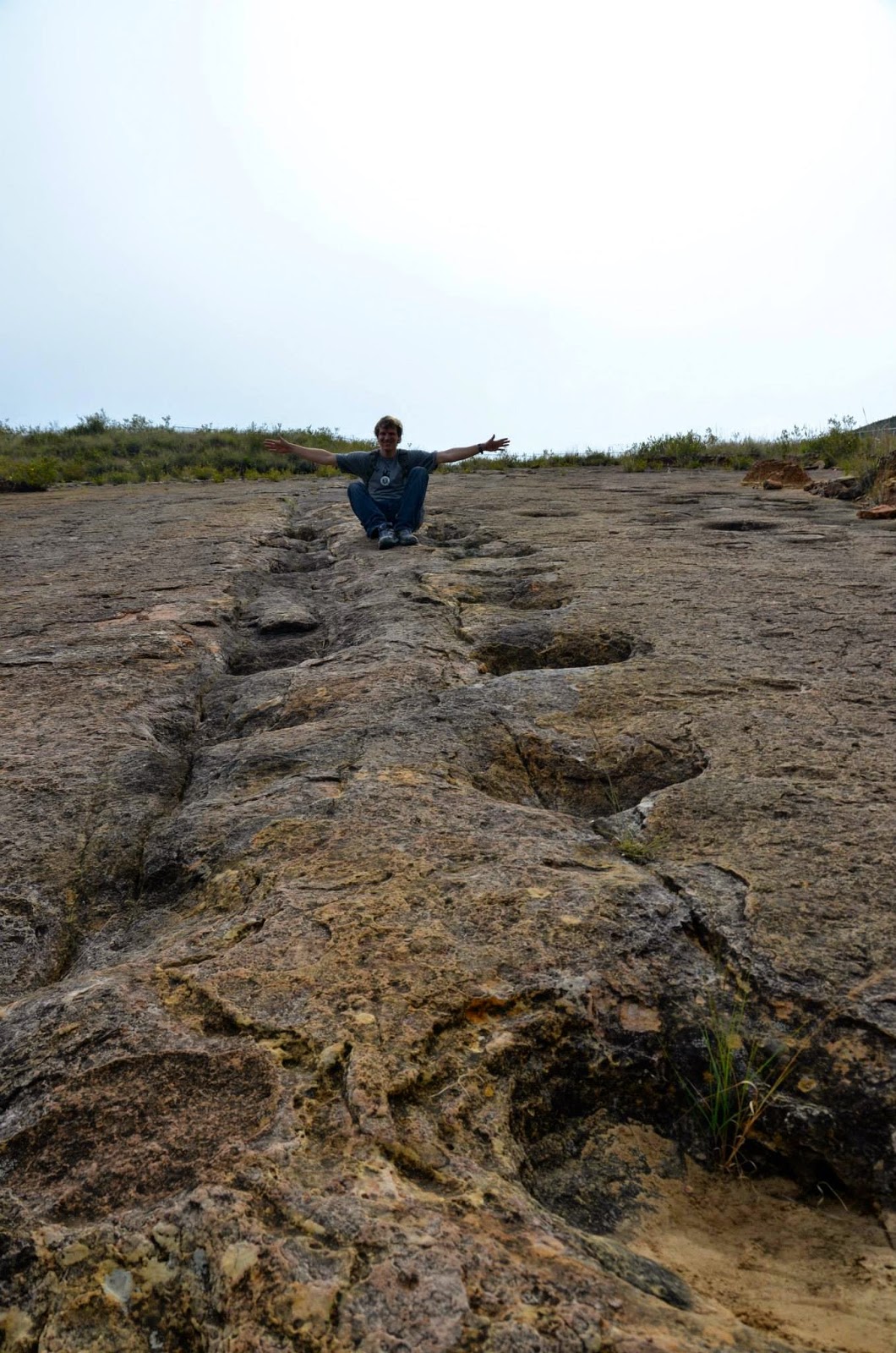
After finding a shop that had breakfast for sale on Easter Sunday, we piled into an off-roading minivan to tour some more of the valley.  Here we got to see both herbivore and carnivore footprints that were fossilised into the ground before the dinosaurs became completely extinct.  The scenery in this part of the valley was absolutely stunning as well.

If you can pick out the three-toed footprint to the left of my right foot in the photo below, our guide told us this type of print belonged to a carnivore.


Below are some herbivore tracks.  Michael could have sat in one as comfortably as one sits in a beanbag chair.

Jalapeño really paled in comparison to this herbivore's footprint, but he did love the view that followed.  In the rainy season, the guide told us that the area in which we were walking becomes a cascade of waterfalls that stream into a river.

Then, the main attraction: a tyrannosaurus rex footprint.  Jalapeño is at the tip of some space between the second and third toe, but wow!  This is where a man and some others asked me to stand with Jalapeño, so they could have a size gauge.  This print was easily four to five feet long and perhaps two to three feet wide.  It was amazing.

Due to the currents caused by the rainy season, some parts of the riverbed were formed into natural bridges that were walkable.  Some parts were quite thin, but this section actually held in place, allowing groups of people to use it without problem.

After seeing the massive footprint of the king of dinosaurs, what could be more or just as impressive?  Well, this view, for one:

As a bonus, we then walked down the stone stairway (that was built into the cliffside) and got to swim in the waterfall that you see in the picture above.  The picture below was another waterfall that we passed by on the way. 


We also had the chance to see other stunning views, flowery vegetation, ancient rock paintings, and more waterfalls on our walk back to Torotoro.  The waterfalls that we swam in were warm, even though the water pools beneath them were quite chilly.  I expect the cloudless day had something to do with it, especially since the waterfalls were high enough to soak up more of the rays that didn't quite reach the pools in the gorge.

When we returned to Torotoro, we had just enough time to collect our things and eat lunch before climbing onto the huge tour bus that would return us to Cochabamba.  In the giant bus, the four-to-five hour trip turned into a six-hour trip, but after the hike, that was fine, too.  The guide was friendly,  informative, and honest; the National Park did not disappoint; and we did not miss our flight back to La Paz.  Definitely a successful weekend overall.


*The photos were a combination of memories taken by Michael Niemann and me.

Saturday, March 7, 2015

Mardi-naval, Carni-gras, and Everything in Between

Eight months in and counting... that is, counting the number of kids in their parents' truck beds, running around the towns loaded with cans of spray foam and sheathing water balloons and water guns beneath their ponchos until the opportune moment.  From Thursday the 12th to Tuesday the 17th (of February), South America celebrates the pre-Lenten season with a huge party.  They call it Carnival, we call it Mardi-Gras, but however you nominate it, one might see it as the most festive event of the year in this part of the world.

Granted, as with every holiday, there are people who start early and don't stop until they're blue in the face and even then you have to wonder sometimes...  As for me, the festival began with Comadres on Thursday; a day originally intended to encourage a mother to celebrate godmother-ship with their child's or children's godmother.  Now, it's encouraged for every woman to take a night out with her best girls.  Without a doubt, this should be adopted into the American holiday calendar.  (There is a Copadres, for father-godfather relationships, too.  It falls on the Thursday before Comadres, but as it is, Commadres is a bigger event.)

A bit out of order, my workplace celebrates the Challa (a day of blessings) on the Friday after Comadres, but it's normally celebrated on the Tuesday after Carnival weekend (known as Fat Tuesday back home), so I'll go into more detail on this event soon, but at work, we "blessed" our good fortunes with food, streamers, confetti, and a firecracker or two.


After the fiesta, Mike and I made last-minute plans to go see the big Carnival parade in Oruro, Bolivia.  Now, Mike had told me that Oruro has two seasons, where the rest of Bolivia more or less has four: Carnival season and not-Carnival season.  Therefore, I was expecting this enormous party, and... I wasn't disappointed.


Our tour bus left La Paz right after breakfast at 4am on Friday morning.  When we arrived in Oruro around 8am, we rubbed excitement back into our eyes, received a care pack with a poncho (perfect for tourists, since gringos are favourite targets for the young-and-armed), a decorated eye-mask, a cd of the songs from the parade, a mini-squirt gun, and a whistle (for participating in the parade).  We would stay as a herd-- I mean, group for the entire day, which was honestly fine by me since this season is known for pick-pockets and other mischief.

Once we got to our tiny seats (perhaps about a foot across, if that... without any extra room and EVERY seat was filled in our area) and all of the tour groups had sorted out where their people would go, Mike and I got to enjoy our front-row seats to all of the chaos.  Traditional dances that told folk stories, hand-made, extravagant costumes, manufactured, vibrant headpieces and accompaniments, venders selling sweets, booze, and food--believe it or not, not ONE vender was selling water...-- and of course the hundred of musicians that marched and danced by in their marching bands.  From the time we arrived at 8am until the time we left, around 8pm, the dancers and musicians never stopped, even for the downpour that lasted for a couple of hours in the middle of the day.  We took so many pictures.  Photo credit goes to Mike for most of these pictures.


Each group is a "fraternity".  As the families and individuals in each fraternity grow and dance together, the sizes of their groups increased with them.  Children danced and paraded beside of elders,  young adults blended with the mixture of ages that surrounded them, twirling their costumes together in unison until you forget that the different ages mean anything at all.


The crowd participated in the party, too.  Spray foam wars broke out every so often among the spectators, making everyone more lively and more willing to participate in the day. --You just had to watch out for your eyes!  That was always the first target... I looked like a red, puffy, drenched mess when I left the parade-- even with my poncho.


Of the dances, I have two favourites: Caporales (bottom left) and Tinku (bottom right).  Both are traditional Andean dances and have strong ties to the history of Bolivia and the culture of its people.

The Caporales is important because the women can dance as the men do and wear traditional men's clothing.  It's an engaging dance that relates back to a character "Caporal" who was an overseer of black slaves, but it also is tied to religion (somehow).  The idea, as I understand it is to dance for the saint that protects the miners, as mining is a significant industry in Bolivia.  I'm honestly not sure how the two ideas were eventually tied together, but the dance is progressive, aggressive, and an utterly memorising experience.

The Tinku, on the other hand, has a darker story behind it-- and it's my absolute favorite.  As it's said, once a year in the springtime, everyone in the town would get together to drink, celebrate, and fight.  I've been told that the fights always resulted in at least one death and much blood was shed; however, these were positive results for a couple of reasons:
1) The people fighting had had an argument sometime that year, and so they were allowed to fight on this day until there was a winner.  Once the fight was over, it was over and done.  There would no longer be any bad blood between the contestants.
2) Any blood that was spilled on this day was considered a blood sacrifice to Pachamama, or Mother Earth, as we would say.  If a person sacrificed his or her life, the gift to Pachamama was honored because it was all the greater gift.

If it's not obvious, no one dies in this parade because they are fighting each other in a dance.  The modern rendition of this ritual is an artistic representation of the history behind the dance.  Thus, the movements are swift and slow.  They beat on the ground with their bare hands (which looks great in the rain!), jump, walk backward, and lean forward while swaying their arms behind them like wind-up toys.  The dance caught my eye because it's magnificently animated and is nothing like the hip-shaking dances that many of the other performers have mastered.  When I first saw it during a practice performance earlier this year, I liked it because they reminded me of storybook characters.  As it turns out, I wasn't too far off the mark.


By the way, there are also "osos" (bears) and "ositos" (little bears).  On two specific occasions, the crowd would chant requests to the performers.  My favourite chant was "O-so! O-so! O-so!" when the bears came around and they would shake and dance for us.  The other was "Be-so! Be-so!" ("Kiss! Kiss!") when a mini-skirt performer passed by.  Sometimes, they would oblige the crowd by dramatically blowing a kiss toward that section.


The entire day was exhausting, but fantastic.  The colors, the costumes, the symbols, the history... everything shuffled and stepped its way into my memory.  We returned to La Paz a little around midnight and, with my puffy-red eyes, and slicked-back hair, I felt a lot like this guy:

.  

AS IF THE FESTIVITIES WERE OVER! Nope.  So, on Sunday we definitely rested.  Shopped, cooked, had chocolates for breakfast to pay respects to the Valentine's Day that passed, and had a water-gun fight in honor of Carnival weekend.  While I didn't get pictures of the water dripping from the ceiling and streaming along the walls and windows of the apartment, I do have this for you:

 .
Monday was also a relaxing day.  This prepared us for Tuesday, the true Challa day, where we were invited to lunch with our landlord (which also means his family and friends and sometimes another tenant or two.)  However, before the meal, Mike and I met Antonio (our landlord) outside of the apartments to bless the homes--with fire, water, alcohol, and flowers.  That's what you can see happening in the photos below.

The sound of firecrackers chorused around the city for the entire day as people blessed their home.  Rubbing alcohol and wine were poured on the ground at the corners of every entrance and flower petals were sprinkled in front of the doorways and at the corner of the doors as well.  There were also streamers wrapped around the top of every doorway (I had to sit on Mike's shoulders to get ours to wrap around the spikes on top of our door.)  All of this in honor of Pachamama (Mother Earth), for what she had given everyone for the past year and what she will bless everyone with this year.


The meal itself was a joyful affair that lasted the entire afternoon and into the evening.  The courses of the meal came in stages: a salad while we waited for the sausages to cook, then sausage sandwiches with rice with cheese.  The main meat was a steak cut into strips and served in stages, so eventually, everyone was well-content with the experience.  Every five minutes, someone would break the constant flow of chatter to raise their glasses for the fine meal, people, or day.  Each cheer was readily accepted and honored.  I have no doubt that Pachamama was smiling on the festivities for that day and the festival as a whole, because it seems that the people here readily take part in every aspect of honoring her.